Why countries trade
Countries differ in their resources, skills and technology, so each can produce some goods at a lower cost than others. If each specialises in what it does relatively best and trades, everyone can consume more than they could on their own.
Hong Kong is a small, open economy. It imports almost all its food, fuel and consumer goods, and earns its living by exporting services (finance, tourism, logistics, trading) and re-exporting goods.
Absolute and comparative advantage
Absolute advantage
A country has an absolute advantage (絕對優勢) in a good if it can produce more of it than another country with the same amount of resources.
Comparative advantage
A country has a comparative advantage (比較優勢) in a good if it can produce it at a lower opportunity cost than another country.
Countries gain by specialising according to comparative advantage, even if one country has an absolute advantage in everything.
Worked example
One unit of resources can produce:
| Rice (units) | Cloth (units) | ||
|---|---|---|---|
| Country A | 60 | or | 30 |
| Country B | 40 | or | 10 |
- Absolute advantage: A produces more of both goods, so A has an absolute advantage in both.
- Opportunity cost of 1 cloth: in A, 60 ÷ 30 = 2 rice; in B, 40 ÷ 10 = 4 rice.
- Opportunity cost of 1 rice: in A, 30 ÷ 60 = 0.5 cloth; in B, 10 ÷ 40 = 0.25 cloth.
- Comparative advantage: A has the lower cost of cloth, so A has a comparative advantage in cloth. B has the lower cost of rice, so B has a comparative advantage in rice.
- Specialisation and trade: A exports cloth; B exports rice.
Terms of trade
The terms of trade (貿易條件) are the rate at which goods exchange, e.g. 1 cloth = 3 rice.
Both countries gain only if the terms of trade lie between their two opportunity costs. Here: between 2 and 4 rice per cloth.
- At 1 cloth = 3 rice, A gets 3 rice for each cloth (it could make only 2 itself), and B pays 3 rice for each cloth (it would give up 4 to make it). Both gain.
- At 1 cloth = 5 rice, B would be worse off than making cloth itself, so B will not trade.
Gains and losses from free trade
Gains: cheaper goods and more variety for consumers; firms reach bigger markets and enjoy economies of scale; competition pushes firms to be efficient; resources move to where they are most productive.
Losses: firms that cannot compete with imports may close, and their workers may face structural unemployment while they retrain.
Trade barriers
| Barrier | Meaning |
|---|---|
| Tariff (關稅) | A tax on imports |
| Import quota (進口配額) | A limit on the quantity of imports |
| Production subsidy to domestic firms | Lowers their costs so they can compete with imports |
| Embargo (禁運) | A ban on trade in some goods or with some countries |
| Administrative barriers | Strict standards or slow procedures for imports |
A tariff in a small open economy
A small open economy cannot affect the world price (Pw). Without trade barriers, the domestic price equals Pw: domestic producers supply Q₁, consumers buy Q₄, and imports = Q₄ − Q₁.
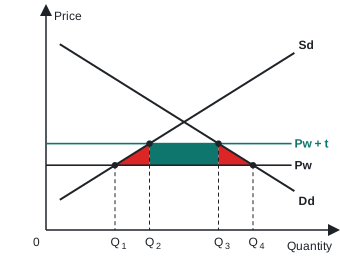
A per-unit tariff (t) raises the domestic price to Pw + t:
| Effect | |
|---|---|
| Domestic price | Rises from Pw to Pw + t |
| Domestic production | Rises (Q₁ → Q₂): domestic producers gain |
| Domestic consumption | Falls (Q₄ → Q₃): consumers lose |
| Imports | Fall (from Q₄ − Q₁ to Q₃ − Q₂) |
| Government | Gains tariff revenue = t × imports (the shaded rectangle) |
| Efficiency | Deadweight loss (the red triangles): too much is produced at home at a higher cost, and too little is consumed |
An import quota has similar effects on price, production and consumption, but the government collects no tariff revenue: the gain goes to whoever holds the import licences.
Why governments protect industries
- To protect jobs in domestic industries.
- To protect infant industries until they can compete.
- For national security, e.g. food or defence supplies.
- To raise government revenue (tariffs).
- To retaliate against other countries' barriers.
Balance of payments
The balance of payments (BoP, 國際收支平衡表) records all economic transactions between an economy's residents and the rest of the world in a period.
Credit and debit
- A credit (貸方, +) item brings payment into the economy, e.g. an export, or a foreigner investing in Hong Kong.
- A debit (借方, −) item sends payment out, e.g. an import, or a Hong Kong resident investing abroad.
The accounts
From the 2028 DSE (updated curriculum): the BoP has three accounts, following the Census and Statistics Department:
| Account | Records | Examples |
|---|---|---|
| Current account (經常賬) | Trade in goods and services, primary income (factor income such as wages, interest, dividends) and secondary income (current transfers such as gifts) | Exports of goods; a Korean tourist's hotel bill in Hong Kong; interest received on US bonds |
| Capital account (資本賬) | Capital transfers and some non-produced assets | Debt forgiveness |
| Financial account (金融賬) | Investment flows and changes in reserve assets | A Hong Kong resident buying German shares; a US firm building a factory in Hong Kong; the HKMA buying US Treasury bills |
You do not need to know the sub-accounts of the capital and financial accounts. Focus on whether and how a transaction affects each account.
For the 2027 DSE: the same transactions are grouped as the current account and the capital and financial account.
Balances
- Visible trade balance: exports of goods − imports of goods. A trade surplus (貿易盈餘) if positive, a deficit if negative.
- Current account balance: the net total of all current account items. A current account surplus means the economy earns more from abroad on current items than it pays.
The BoP always balances
In the accounting sense the BoP always balances: every transaction is recorded twice, once as a credit and once as a debit, and a net errors and omissions item covers measurement gaps.
When people speak of a BoP surplus (國際收支盈餘), they mean the economy's official reserve assets rose; a BoP deficit means its reserves fell. A current account deficit does not necessarily mean a BoP deficit, because it can be offset by inflows recorded in the financial account.
Foreign and official reserves (外匯儲備) are foreign assets held by the monetary authority (in Hong Kong, the HKMA, through the Exchange Fund). They are used to keep the exchange rate stable and to meet international payments.
Exchange rates
The exchange rate (匯率) is the price of one currency in terms of another, e.g. HK$7.80 = US$1.
- A currency appreciates (升值) when it buys more foreign currency.
- A currency depreciates (貶值) when it buys less foreign currency.
Effects of a change
If the Hong Kong dollar depreciates against the yen:
- Hong Kong goods and services become cheaper for Japanese buyers → Hong Kong exports tend to rise.
- Japanese goods become dearer in Hong Kong dollars → imports from Japan tend to fall.
- Hong Kong residents travelling to Japan find it more expensive.
Exchange rate systems
- Floating exchange rate (浮動匯率): set by the demand for and supply of the currency.
- Fixed exchange rate (固定匯率): kept at a set level by the monetary authority. Hong Kong's Linked Exchange Rate System fixes the HK dollar at about HK$7.80 = US$1 (see Money and Banking). So the HK dollar moves with the US dollar against other currencies: when the US dollar strengthens against the yen, so does the HK dollar.
How DSE tests it
- Comparative advantage (MC and short questions): find opportunity costs from a table, name each country's comparative advantage, and test whether given terms of trade benefit both.
- Tariffs and quotas: "With the aid of a diagram, explain the effects of the tariff on domestic production, consumption and imports." Label Pw, Pw + t, and the quantities.
- BoP: "Which of the following is included in the current account?" / "Explain whether a current account deficit means a BoP deficit."
- Exchange rates: effects of an appreciation or depreciation on exports, imports or tourists.
Answer template for comparative advantage (4 marks): calculate each country's opportunity cost of the good (1 + 1); compare and conclude who has the comparative advantage (1); state what each country should export (1).
Common mistakes
- Saying a country with an absolute advantage in both goods gains nothing from trade. Gains come from comparative advantage.
- Comparing outputs instead of opportunity costs when finding comparative advantage.
- Forgetting that mutually beneficial terms of trade must lie between the two opportunity costs.
- Putting buying foreign shares in the current account. It is in the financial account.
- Saying a current account deficit must mean a BoP deficit.
- For the 2028 DSE, writing "capital and financial account" as one account. From 2028 they are two accounts.